I’ve spent a little more than a year building Unleash the Avatar, a third person action RPG that’s set in India.
At this point, I have been on 100s of hiring calls to fill many roles, such as rigging, animation, modeling, VFX, programming etc. I feel like I have a unique perspective because I understand a little bit of everything, and some things really well.
As a co-founder, a lot of my time goes in hiring, real-time game VFX and programming.
Recently, we got covered by Asmongold, have gone viral in China (our trailer is the 6th most watched video on IGN China on Bilibili, their version of YouTube), and have got generally good coverage on our 2nd trailer that launched a few months ago on YouTube and other social platforms as well.
The other reason I was motivated to make this post is because I think game development as a field is a massive walled garden. Before this, I was building a software company, and everything felt so…open.
Whereas with games, knowledge is hard to come by. Just compare the quality and number of tutorials on YouTube vs other fields, you’ll get the idea.
I think the reasons are two-fold:
- Game studios want to guard their secrets to have a competitive advantage (in software, people are usually building different things for different use cases, whereas in games, you’re competing for a finite pool of people’s time).
- The second is that it’s genuinely hard - especially because you need to be knowledgeable a lot of times about both art and tech (read: have taste and skills)
I also want to mention that the industry has been on a general down-trend due to lots of layoffs. That doesn’t change which roles are structurally scarce, but it does change how many openings exist at any given moment.
The other is that this is skewed towards building a big game, specifically in Unreal Engine (or similar), and trends that I see in India.
With that being said, let’s talk about the roles in game development. I’ll categorize based on several factors like demand, saturation, and how the roles may change due to improvements in technology.
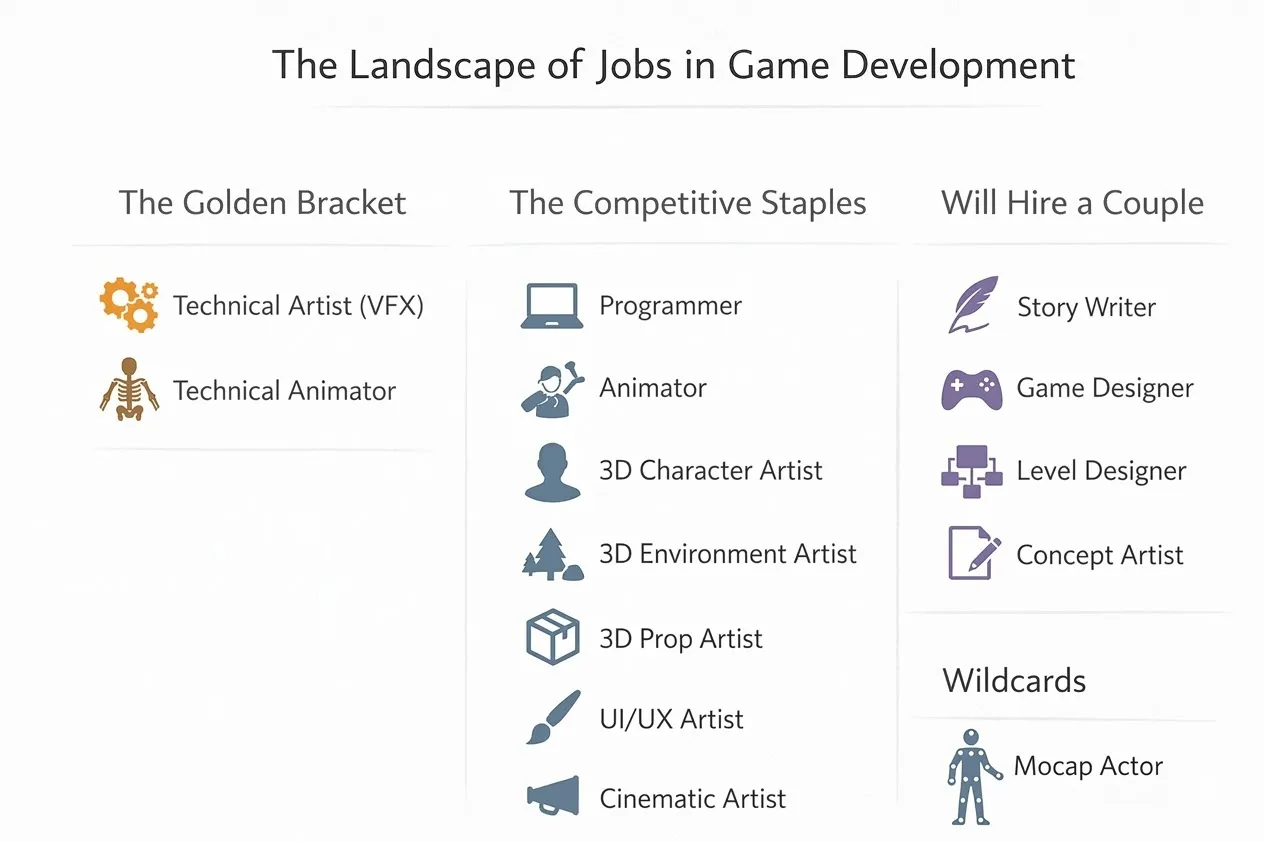
The Golden Bracket
Technical Artist
Sometimes, I will use technical artist and VFX artist interchangeably. They are different however, as VFX art is a subset of what a technical artist does in a studio.
In my opinion, this is one of the best roles given how in demand it is, compared to its saturation level.
I read that art universities produce 1000 concept artists for every 1 game VFX artist. That’s insane, especially considering the demand for game VFX is growing.
I personally switched over to doing VFX for the project once programming was in a good place, since we were bottlenecked.
I didn’t know at the time, but this was a really good decision. First of all, I really enjoy doing it. Second, it’s a mix of a type of programming (through shaders i.e materials in Unreal Engine), and art, which gives me a high level overview of everything we do at our studio.
It’s hard (and valuable), because many people who are good at art don’t have technical knowledge, and many who are technically capable can’t be bothered with art. You need taste and skills.
Some might argue that:
- many companies hire VFX artists on contract/freelance basis, and this does not provide stability,
- it’s still a high intensity role with potential burnout because of how demanding it is
While this is partially true, it still doesn’t combat the problem of how shallow the pool of VFX/technical art talent really is. Furthermore, as you get really good at it, a lot more opens up for you:
- Being good at shaders also helps with environment, characters, and the rest of your art in game,
- You can also help a ton with interaction in games, as particles can be driven through collisions, events in the world, etc (e.g: leaves that move with the character, roaches that scuttle around based on light sources, applying blood on an enemy when hit, sand interacting with your feet etc),
- You can flex into cinematics, as you naturally end up becoming comfortable with Sequencer anyway,
- If you’re a small studio, you also help a ton with general game feel, as a large part of your role involves making abilities feel good.
- Broadly, VFX artists are a subset of Technical Artists, for which demand will only continue to climb.
Technical Animator
To explain why this role is important, I would like to walk you through a little bit of history.
Character animation is an important (and tedious) part of building games. For decades, a character artist would make a character, and hand it over to a Rigging and Skinning Artist (R&S), who would then prepare the model for animators. The animators would then create (or cleanup) animations to bring the character to life. In short, R&S serves as a bridge between character artists and animators.
I think that’s changing a lot. For example, Unreal Engine now heavily invests in a tool called Control Rig, which is basically like a programming toolkit to make procedural rigs. I’m sure other studios with their proprietary engines are investing in something similar as well.
A technical animator is someone who is very good at navigating animation tools in the engine.
- They can put together and tweak animations that come in from animators, and make it viable for gameplay,
- They also do procedural physics and animation, (eg: running physics simulations like RBANS, doing motion matching etc) through Control Rig and a host of other new features in the engine. Sometimes, the R&S artist gets involved as well.
An example, when a creature like an octopus moves, it is extremely tedious to animate 8 legs. A toolkit like Control Rig allows a technical animator (or rigging artist) to add logic such that, if the movement of the octopus is keyframed by an animator, all the legs will procedurally animate without you lifting a finger.
The things that you can cover are endless. Here are some examples:
- Chaos cloth for realistic hero cloth simulation,
- RBANs and Anim Dynamics for physics based movement on saddles, chains, a player’s sash, flask attached to the waist etc,
- High fidelity locomotion animations, through motion matching, foot IK, retargeting, foot placement etc (Epic Games themselves use this stuff heavily in their Game Animation Sample),
- Procedural animations for creatures.
The real reason these 2 roles are so important is because every modern game wants things in their scene to move and react to feel alive. Sucker Punch (creators of Ghost of Yotei) has an entire blog post about this topic!
The competitive staples
Programmer, Animator, 3d Character Artist, 3d Environment Artist, 3d Prop Artist, UI/UX Artist, Cinematic Artist, Sound Design
These are roles that will exist in almost every studio. They’re high in demand, and are generally competitive roles. Senior, experienced and/or exceptionally talented people are highly valued here.
- Having a handful of stellar programmers improves productivity by 50-100x. Having lots of editor tools, improving rendering and other pipelines, optimization, CI/CD etc.
- Cinematic artist is high in supply because a lot of people port over from the film/VFX industry to try their hand at games, and it translates well (like in our case). But a good cinematic artist can contribute parallely to level design, concepts and generally help with tying things together well. A good cinematic artist also reduces the work of animators by a lot if the shots are pre-planned well.
- 3d artists enjoy tools that are getting rapidly better. Metahuman creator/CC4 helps character artists pump out different types of characters quickly. Environment artists have a massive library in Quixel, Fab etc to quickly build things. However, you need a stellar cast here to plan out call out sheets, trimsheets, modular kits and other things that cut your production time,
- Animation is a difficult role to fill, as you need exceptional talent. The best animators I have personally seen are also the ones who are good choreographers — they can think in terms of acting and not just the technical skill of cleaning up mocap data or keyframing,
I see these roles progressing the same way programming is going. You want to hire fewer, but exceptional folks because otherwise they’re a net negative.
Wildcards
Mocap Actor
This is an underrated role that is hard to hire for. There are plenty of actors who would like this sort of work, but there is a lot of nuance to it:
- For the basics, you need to be fit and a good actor to do mocap well. Check out some of the mocap done for God Of War, Black Myth Wukong etc. on YouTube,
- Acting is higher prestige in traditional acting like movies, shows etc. I don’t know how many take game mocap acting seriously as an opportunity,
- A lot of the time, this role is outsourced to an agency to perform all the mocap, but I don’t think we have enough of those here in India.
Will hire a couple, but need exceptional
Story Writer, Game Designer, Level Designer, Concept Artist
These roles are already few in number in a studio, and you only want to hire the best. The reason I don’t put them under competitive staples is because there’s a low barrier to entry to most of them (except maybe concept art, which is also changing), and you don’t necessarily require a hard skill. It’s very taste driven.
The bar, however, keeps getting higher. I recently heard of one studio that won’t allow you to interview for a game designer role without showing them your Steam library. Expect more of these extreme things to happen.
The people who get these roles however, enjoy amazing benefits.
- Programmer productivity has increased massively, which means they can build editor tools at will for level and game designers to tinker with gameplay and level blockouts. You can be quick to prototype and throw away things,
- Story writers get access to more and more information, and AI helps them a lot with synthesis and uncovering new information. AI is very poor at writing good stories however, and will not touch this role.
I have left out voice acting and music. We will cross that chasm later as we come to it in production.